
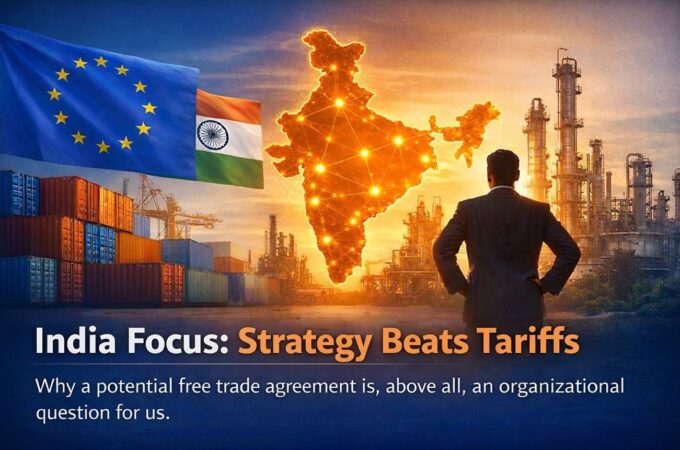
Why a potential free trade agreement is, above all, an organizational question for us?
I am Siggi. I know the chemistry in Asia.
The potential free trade agreement between the EU and India is currently being discussed intensively. I assume that we will have clarity by the end of 2026. For chemical distribution, however, this is less a question of tariffs and much more a fundamental organizational issue.
Whether and when such an agreement will formally come into force remains to be seen. What matters to me is something else: Are we already organizationally prepared today, or do we only start thinking seriously once the contracts are signed?
A free trade agreement does not change supply chains by itself. It changes the rules of the game. And this is exactly where the difference between purely operational handling and strategic preparation becomes visible.
Three critical points for practice:
• Structure before tariffs: Those who do not build reliable supplier structures in India today will not gain a real advantage later from a potential reduction or elimination of tariffs. Partnerships in India are built on time and on trust that grows over years.
• Compliance advantage: Those who only address regulatory topics such as REACH roles, documentation quality and data availability after an agreement is signed lose valuable time in market access.
• India as an independent chemical hub: India must not be viewed through a China lens. It is neither a fallback option nor a price driven alternative, but a highly complex chemical production location with its own technological strengths and a clear expectation of partnerships on equal footing.
What is often underestimated is that success does not depend only on external supplier structures, but also on internal organization. Clear responsibilities, sufficient resources and clear prioritization are prerequisites for developing India strategically.
A potential free trade agreement would accelerate developments that are already visible today. It would not create structure. That structure has to be in place beforehand.
The key question, therefore, is not only if or when an agreement will come. The real question is whether our organizations are already set up today to actually make use of this lever.
That’s the chemistry.
Siggi.